

The Best Harness for a German Shepherd That Pulls (From an Owner Whose
A quick note from the founder: If you've ever had your arm yanked out of its socket by a German Shepherd who spotted a stray cat, you aren't alone. This isn't a list of generic affiliate links scraped from Amazon. This is the exact breakdown of how we stopped the pulling nightmare without choke chains or painful prong collars.
The "Freight Train" Problem: Why German Shepherds Pull So Hard
German Shepherds are magnificent creatures, but walking an untrained or reactive one in a suburban neighborhood can feel like holding onto the leash of a runaway freight train.
Here's the biological reality most first-time GSD owners don't realize: German Shepherds were bred for herding and pastoral patrol. They have a massive lung capacity, a low center of gravity, and a deep, muscular keel (chest) designed to propel them forward effortlessly for hours across rugged terrain.
When a German Shepherd pulls against a leash attached to a standard back clip or collar, their natural opposition reflex kicks in. That means the harder you pull back, the harder their muscles instinctually dig in and pull forward. If your dog weighs 75 to 90 pounds and bolts after a bicycle or a neighbor's golden retriever, that sudden surge delivers hundreds of pounds of kinetic force straight into your wrist, elbow, and rotator cuff.
The Hidden Danger of Walking a Pulling GSD on a Neck Collar
For decades, old-school trainers told people to just snap a flat collar or slip lead on and "give a firm correction." But veterinary medicine has advanced, and the radiographic evidence is alarming.
A dog's neck houses their trachea (windpipe), thyroid gland, esophagus, and delicate cervical vertebrae. When a heavy, deep-chested dog hits the end of a 6-foot leash at full speed on a flat collar:
- Tracheal Trauma: Repeated high-pressure impacts can cause chronic coughing, reverse sneezing, and permanent cartilage damage.
- Intraocular Pressure: Studies published in veterinary ophthalmology journals found that neck pulling dramatically spikes pressure inside canine eyes, compounding risks for glaucoma.
- Cervical Disc Strain: Whiplash-like jerk forces wear down spinal discs, leading to mobility issues and nerve compression in their senior years.
If your German Shepherd is a puller, keeping a leash on their neck collar is a gamble with their long-term health. A properly engineered harness is non-negotiable.
Why 90% of Standard Pet Store Harnesses Fail on German Shepherds
Most commercial harnesses you find at big-box pet stores are designed for Golden Retrievers, Labradors, or French Bulldogs. When you try to put them on an adult German Shepherd, three glaring design flaws immediately show up:
The 3 Fatal Flaws of Cheap Harnesses:
- The "Side-Slide" Effect: Because German Shepherds have a narrow waist and a dramatically deep ribcage, standard step-in strap harnesses twist and slide around sideways the moment slight leash tension is applied.
- Brittle Plastic Buckles: Cheap POM plastic side buckles are only rated for 40–50 lbs of static weight. Under sudden kinetic shock from a 90 lb dog, those plastic tines can sheer clean off.
- Armpit Chafing: Flimsy nylon webbing cuts straight into the thin, sensitive skin behind a GSD's front armpits, creating painful friction sores and raw hot spots.
The Secret to Stopping the Pull: Front-Clip Steering Physics
If you want to stop pulling without causing pain or fear, you have to understand leverage.
When you attach a leash to a dog's back, you give them a sled-dog pulling rig. Their chest muscles are free to bear down and tow you down the sidewalk.
However, when you attach the leash to a reinforced front chest D-ring, the mechanics change completely:
- The moment your German Shepherd tries to surge forward, the leash pulls against their sternum.
- This gently redirects their shoulders and torso sideways back toward you, breaking their forward momentum naturally.
- Because they can't establish forward leverage, pulling feels completely unrewarding, so they quickly learn to match your walking pace.
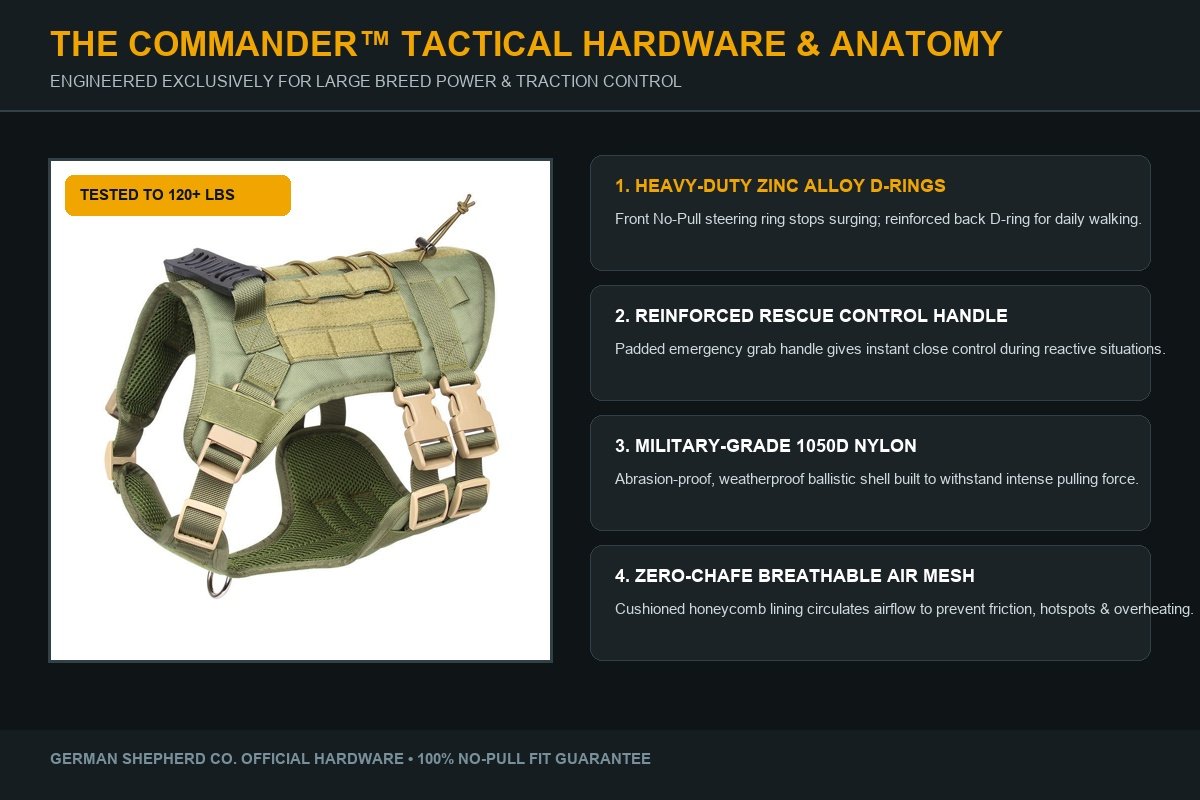
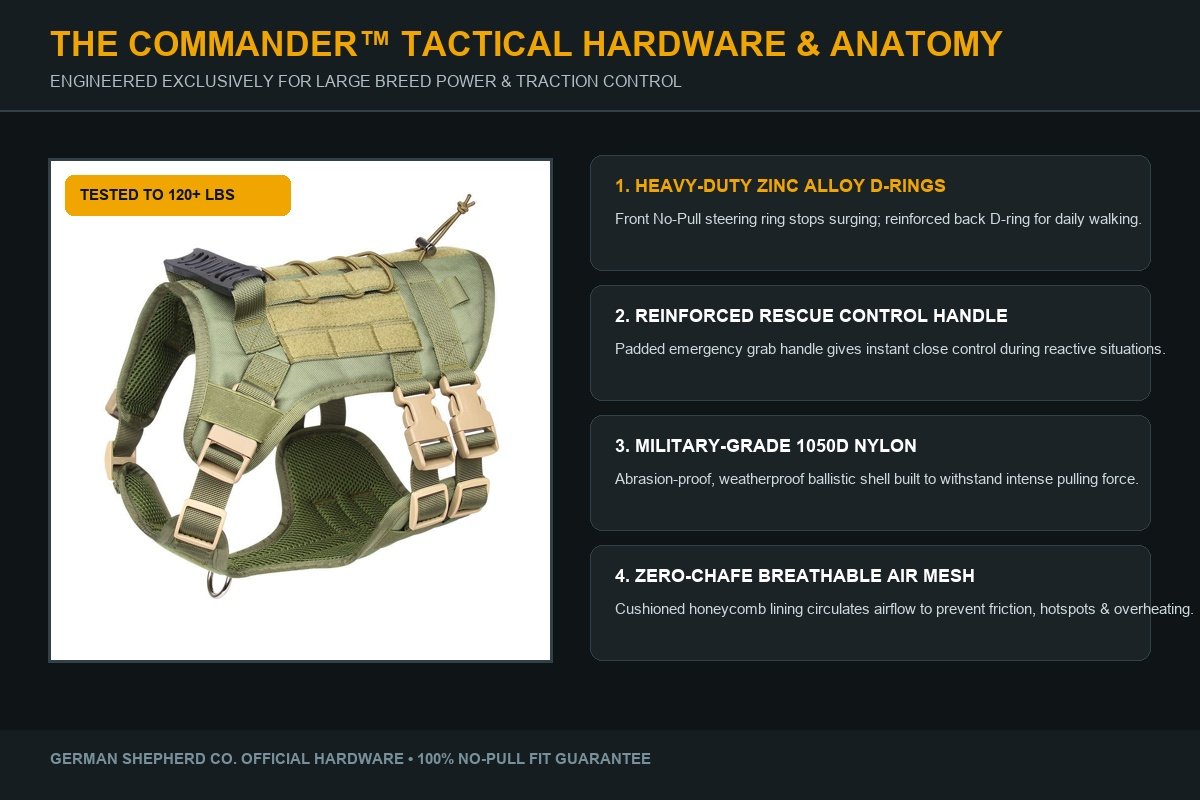
The Commander™ Heavy-Duty Tactical No-Pull Harness
Engineered specifically around the deep-chested anatomy of German Shepherds. Features military-grade 1050D nylon, reinforced dual zinc-alloy D-rings (front no-pull + back walking), and an emergency top rescue control handle.
⚡ Eligible for 10% off with code GSD10 • Free US Shipping over $65 • 30-Day Perfect Fit Guarantee
The Importance of the Top Control Handle (Real-Life Scenario)
If you've spent any time around German Shepherds, you know that even the most obedient dog can have an unpredictable reaction. Maybe a neighbor's off-leash dog charges around a blind corner, or a child drops an ice cream cone right next to your dog's nose.
In those split seconds, fumbling to reel in six feet of nylon leash is dangerous.
Having a reinforced, padded top control handle directly over your dog's shoulder blades gives you immediate physical leverage. You can pull your dog tight against your hip, step in front to break eye contact with the trigger, and keep everyone safe without putting undue pressure on their spine.
How to Accurately Measure Your GSD (Because A Loose Harness is Useless)
A harness that fits too loosely will rub, chafe, and allow a clever dog to back out. A harness that is too tight will restrict shoulder mobility and cause friction sores.
Take 60 seconds and a soft measuring tape:
| Size | Chest Girth | Neck Girth | Typical Age / Weight |
|---|---|---|---|
| Small (S) | 20.5" - 27.5" (52 - 70 cm) | 18.0" - 22.0" (46 - 56 cm) | Puppies / 4–7 Months (30–50 lbs) |
| Medium (M) | 23.5" - 31.5" (60 - 80 cm) | 20.0" - 26.5" (50 - 68 cm) | Young Dogs / Small Females (50–70 lbs) |
| Large (L) | 28.5" - 39.5" (72 - 100 cm) | 24.5" - 31.5" (62 - 80 cm) | Standard Adult Males & Large Females (70–95+ lbs) |
Frequently Asked Questions from German Shepherd Owners
Will a no-pull harness hurt my German Shepherd's shoulders?
Not if it is designed properly. The key is to look for an anatomical chest plate that sits above the shoulder joints, rather than horizontal chest straps that pin the shoulders back. The Commander™ harness allows full, uninhibited range of motion during natural gait and running.
Can my GSD back out of this harness?
German Shepherds have narrow waists relative to their ribcage. When adjusted to the recommended two-finger rule (snug enough that only two fingers fit underneath the straps), the anatomical shape makes it virtually impossible for your dog to back out or slip free.
How long does it take for a German Shepherd to stop pulling?
Most owners notice an immediate 60–80% reduction in pulling power on their very first walk using the front chest D-ring, because the dog cannot gain forward traction. Combined with consistent praise and high-value treats whenever they keep slack in the leash, most GSDs master loose-leash walking in 1 to 2 weeks.
Transform Your Daily Walks Today
Stop dreading walks and start enjoying peaceful adventures with your German Shepherd. Backed by our 30-Day Perfect Fit Guarantee and tracked US delivery in 6–12 days.
Order The Commander™ Harness Now →SHARE: